Better Together: How to Crochet Stitches Together
- Jul 21
- 3 min read
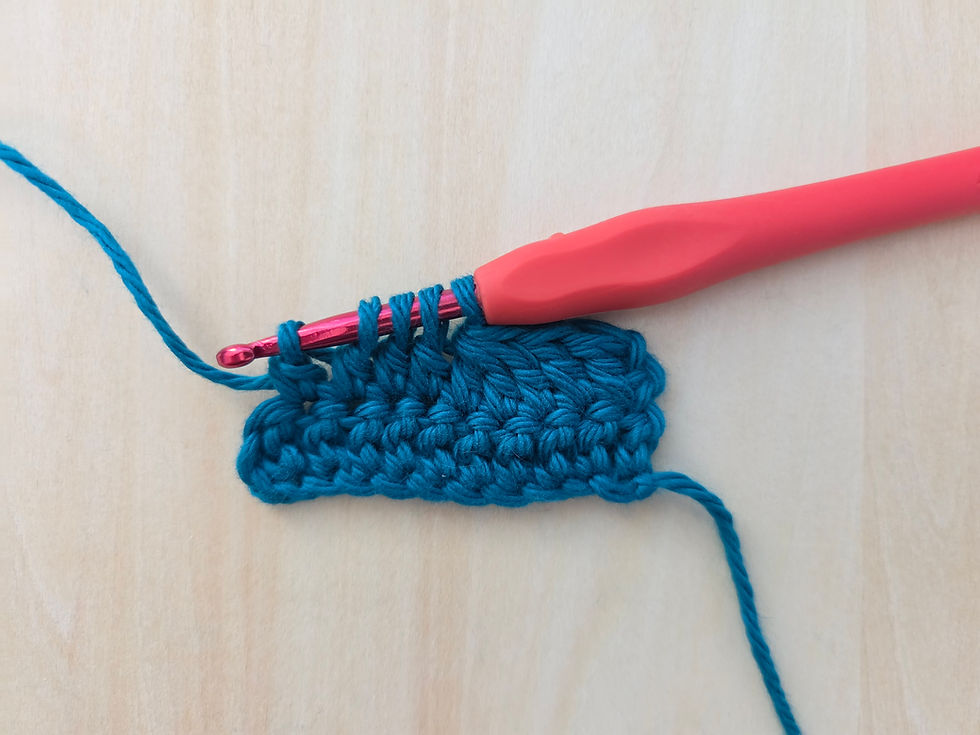
In this post, we are going to talk about decreases, cluster stitches, and those “together” abbreviations you sometimes come across in crochet patterns.
I know they can seem confusing when you come across something like dc3tog but after this post you won’t have to stop and look up how to do it anymore.
The good news is that these stitches all use the same basic idea and once you understand that idea, the abbreviations are a lot easier to follow.
What Is a Decrease?
A decrease takes two or more (but usually just two) stitches and turns them into one.
You do this by beginning the first stitch but then stopping before the final step. Then you begin another stitch in the next stitch, again, stopping before the final step. Once the partial stitches are on the hook, you do the final step for both of them together.
You will frequently see decreases in crochet patterns and usually they will be explained but if not, a good rule of thumb is to have the decrease match the stitches you are already using. If you’ve been doing Single Crochet, use a Single Crochet decrease.
Here’s how each one works.
Single Crochet Two Together (sc2tog)
A regular Single Crochet is made by inserting your hook into the indicated stitch, yarn over, pull up a loop, then yarn over again and pull through both loops on your hook.
When making a Single Crochet Decrease, you begin the stitch normally but stop before the final yarn over.
insert your hook into the indicated stitch
pull up a loop (you now have 2 loops on your hook)
insert your hook into the next stitch
pull up a loop (you will now have 3 loops on your hook)
yarn over and pull through all 3 loops
You have now completed an sc2tog.
Half Double Crochet Two Together (hdc2tog)
A regular Half Double Crochet is done by starting with a yarn over. We then insert your hook into the indicated stitch and pull up a loop. Then we yarn over again and pull through all three loops on your hook.
To make the Half Double Crochet Decrease:
yarn over and insert your hook into the indicated stitch
pull up a loop (you now have 3 loops on your hook)
yarn over and insert your hook into the next stitch
pull up a loop (you now have 5 loops on your hook)
yarn over and pull through all 5 loops
You have now completed the hdc2tog.
Double Crochet Two Together (dc2tog)
A Double Crochet Decrease follows the same basic idea. Begin the first Double Crochet, stop before the final step and then begin the second Double Crochet and finish together.
yarn over and insert your hook into the indicated stitch
pull up a loop (you now have 3 loops on your hook)
yarn over and pull through 2 loops (you have 2 loops left on your hook)
yarn over and insert your hook into the next stitch
pull up a loop (you now have 4 loops on your hook)
yarn over and pull through 2 loops (you now have 3 loops on your hook)
yarn over and pull through the final 3 loops on your hook
You have no completed the dc2tog.
How to Read "Together" Abbreviations
Once you understand how a decrease works, the abbreviations are much easier to read.
Let's use the sc2tog as an example.
The "sc" refers to the type of stitch. In this case, Single Crochet.
The "2" refers to how many stitches we are working together. In this case, 2.
And finally the "tog" stands for "together".
So when we put them all together it's telling us to single crochet 2 stitches together.
A dc4tog is telling us to Double Crochet 4 stitches together. Meaning it will be worked across 4 stitches from the previous row.
Are Clusters and Decreases the Same Thing?
The decreases we just made are also called "Cluster Stitches". Just like we did above a Cluster Stitch is created by beginning several stitches and then moving to the next one just before the final step.
There is no set number of stitches in a cluster. The stitch type and number of stitches depend on the pattern. Clusters are sometimes used as decorative stitches below a fan or shell stitch.
Main Idea Takeaway
Whether the pattern calls it a decrease, a cluster, or a "together" stitch, the basic method is the same.
Begin each stitch, stop before completing the final step and then complete all the partial stitches together.
Once you understand that, abbreviations such as sc2tog, hdc2tog and dc4tog are much easier to read.
Crochet Stitch Library is ad free and supported by readers. If this tutorial helped, you can Buy Me a Skein.


Comments